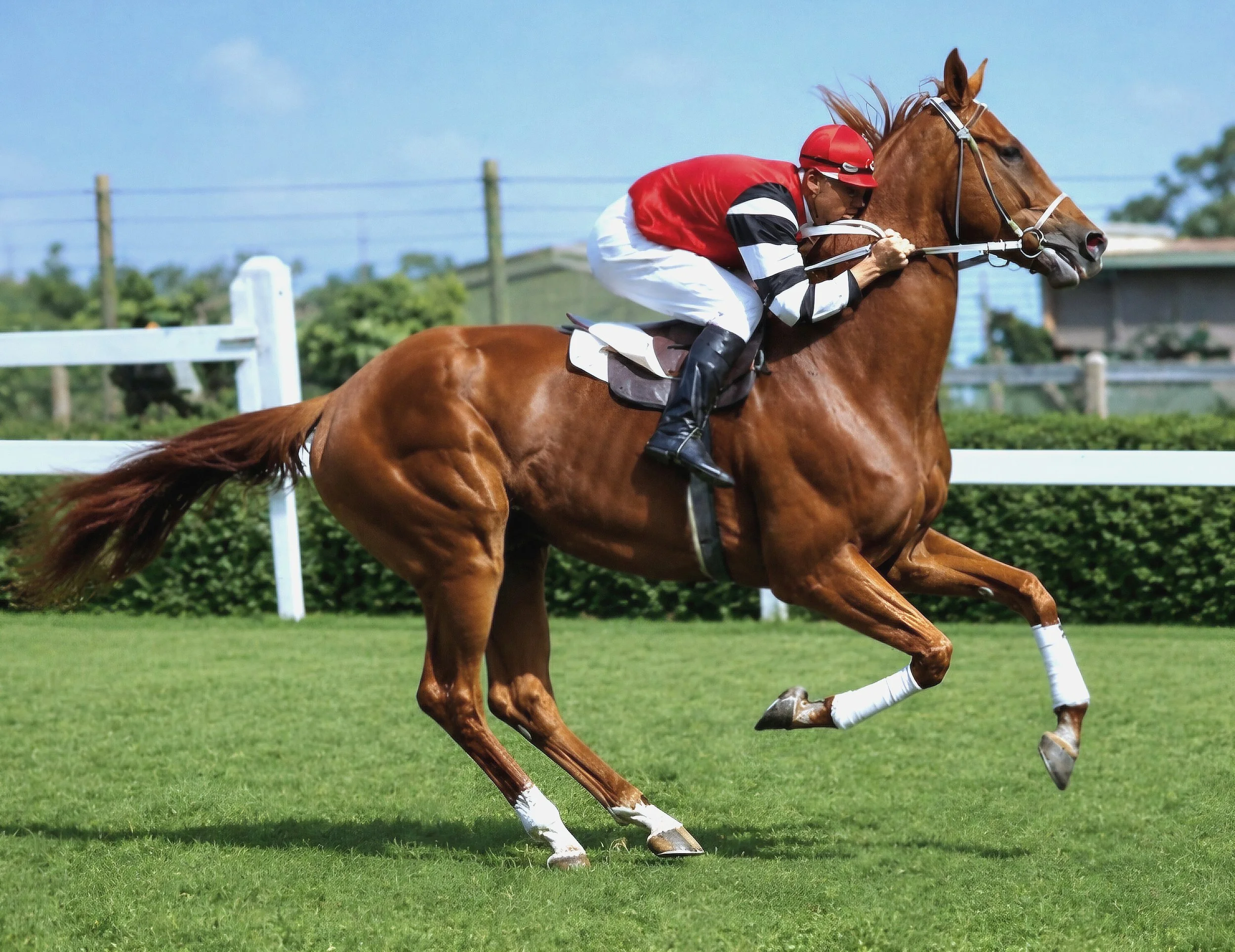
PHAR LAP
Phar Lap, known as 'The Red Terror,' captivated racegoers throughout the 1930s, achieving legendary status during his lifetime, posthumously, and continuing to be revered a century later.
PHAR LAP, the iconic Australian thoroughbred racehorse, achieved legendary status during a long period of economic hardship in the 1930's. His remarkable physical attributes and dominant performances on the racetrack captivated Australian audiences of the era, elevating him to a symbol of national pride. However, his untimely demise which remains a mystery to this day, further cemented his place in history as a beloved figure in the equine racing world. The beginning of Phar Lap's story was hardly the stuff of legends. His parents weren't well-bred, but lowly underachievers, and as a foal and also yearling, PHAR LAP was a large, ungainly specimen, seemingly more well suited to steeplechasing than running on the flat. He was sired by the imported stallion NIGHT RAID out of the broodmare, ENTREATY, sold at the 2nd annual NZ Yearling Sales in Wellington.
NIGHT RAID was sired by the Doncaster Cup and Goodwood Cup winner, RADIUM, and his dam SENTIMENT was by the Derby winner and good sire SPEARMINT. Night Raid served one season at Wagga Wagga stud in Australia during 1923 and then resumed racing. He was retired to stud in New Zealand in 1924, sold for 700 guineas to A.F Roberts. He also sired the brilliant New Zealand galloper NIGHTMARCH among 13 stakes winners. It was in Timaru where PHAR LAP was foaled October 4th, 1926. ENTREATY, the mother of the future champion had broken down after her only appearance and Roberts had acquired her for a paltry 60 guineas. Phar Lap was her second foal. MUSKET, the sire of the great CARBINE, appeared on both sides of his pedigree.
PHAR LAP emerged as an exceptional contender among thoroughbred champions in the late 1920's and the very early 1930's. Born in Seadown Timaru, New Zealand, in 1926, he was acquired for a modest sum of 160 guineas by trainer Harry Telford on behalf of a buyer. Upon his arrival in Australia, his new owner, Mr. David J. Davis, an American national, expressed initial reservations regarding the horse's physical attributes, calling the imported equine, a “Dog Kangaroo.”
PHAR LAP presented as slender and ungainly, with noticeable sores adorning his head. Davis conveyed his gross displeasure to the Telford, who had initially convinced him to invest in the purchase of the horse. Unwilling to incur further financial outlay for training expenses, Davis opted to lease Phar Lap to Telford for a period of three years as the trainer had no means to buy the horse. Under this arrangement, Harry Telford assumed responsibility for the horse's training, feeding and retention of any winnings. Telford, possessing extensive knowledge of racehorse lineages firmly believed that Phar Lap's pedigree destined him for championship status and was willing to take on the challenge.
Despite being named PHAR LAP, (which translates to 'wink of the skies' or 'lightning' in Thai), the horse was affectionately known as 'Bobby' around the stables. Tommy Woodcock, a young and dedicated stable boy, assumed the primary role of caring for Phar Lap and his name is forever linked with the legend. The horse exhibited a docile and easy-going nature, often engaging in playful antics with Woodcock. Their bond grew so strong that Phar Lap refused to eat unless Woodcock was present in his stall.
Phar Lap's initial racing endeavours in 1929 yielded modest results, with no notable placements in his first four races. However, his fortunes turned on 27th April, when he secured his maiden victory at Rosehill near Sydney. Telford had set Phar Lap up for that race at Rosehill and got a friend to back him on his behalf getting as much as 20/1. Despite subsequent unplaced finishes in four more races, he achieved a commendable second-place finish in the Chelmsford Stakes on 14th September. Remarkably, he only experienced one more unplaced finish throughout his illustrious career, which occurred in the prestigious Melbourne Cup of 1931.
To mitigate the impact on the gelding's legs, Telford occasionally exercised Phar Lap on the expansive sandhills bordering Victoria Park, personally riding the horse in a stockman's saddle through the loose sand. The trainer's financial constraints, specifically their inability to afford consistent grass gallops at Kensington, necessitated this alternative approach to training at the seaside. Phar Lap demonstrated exceptional prowess on the racetrack from that point forward, achieving remarkable victories in some of Australia's most famous races. Notably, during the Spring Racing Carnival of 1930 where he accomplished an extraordinary feat by winning an impressive four races within a single week. It laid the foundation for a spring campaign that would go down in history.
From September 1929 onwards, Phar Lap consistently held the favoured position in nearly all of his races, a testament to his exceptional talent and dominance on the turf. Phar Lap possessed impressive physical attributes, standing at 17.1 hands high with powerful leg muscles and a robust heart, which, upon his passing, was discovered to be one of the largest ever found in a racehorse. While primarily known as a stayer, excelling in races over extended distances, he also demonstrated remarkable success in sprint races, showcasing his versatility and athleticism.
Jockey Jim Pike accepted the ride on Phar Lap in the Derby after a fine fourth place behind LIMERICK, MOLLISON and WINALOT (who Pike was on) in the Warwick Stakes. As the distances of his races increased, Phar Lap now began to come into his own, finishing a close 2nd to MOLLISON in the nine furlongs (1800m) Chelmsford Stakes after being trapped wide throughout. A week later Phar Lap was partnered by Jim Munro in the Rosehill Guineas and recorded only the second win of his career. Without being ridden out, Phar Lap won by three lengths and was extending his margin at the post. Clearly, nothing behind him that day was going to trouble him in the Derby, and he was immediately promoted to the top line of betting as the 6/4 favourite for the classic.
In record-breaking A.J.C. Derby it was the only time in the entire race that Pike asked the big chestnut to do any serious work and in the twinkling of an eye he had opened up four lengths on the rest of the field, coming off a breakneck pace. Phar Lap came into the Randwick straight three lengths clear to run home the easiest of winners. The A.J.C. Derby was worth £6,735 to the winning owner, plus a breeder’s bonus of £400, and took Phar Lap’s earnings to £8,430 in less than six months. The son of Night Raid travelled so fast in the final furlong of the Craven Plate that PHAR LAP won by four lengths in the mud from MOLLISON, with AMOUNIS a further ten lengths adrift.
In the VRC Derby, Pike made a lightning dash from second last to about third approaching the nine-furlong post. After that, it was merely a procession. Taking the lead going into the straight Phar Lap wasn’t pushed to beat CARRADALE again. In the process, Phar Lap clipped a quarter-second off the record time set by MANFRED only four years earlier. In less than ten weeks this awkward gelding had risen from obscurity before the Warwick Stakes in late August to absolute domination of Cup betting.
In his first Melbourne Cup, Phar Lap had been allotted 7st 6lb (47kg). To a large extent, Phar Lap was a victim of his own success. Due to the light weight, Pike was replaced by Bobby Lewis, with no less than four Melbourne Cups among countless other victories, but he is best remembered for this losing ride. The small field resulted in the absence of pace, and this was one of the two critical factors that brought about his defeat. The other was the presence of NIGHTMARCH. Without a pacemaker Lewis was forced into leading the Cup field and was never worse than second in the running. But the pace was so slow for the first mile that Phar Lap wasted a lot of energy fighting for his head in those first six furlongs. In the wake of his Cup defeat, most grandstand critics rounded on Lewis, while others muttered that perhaps Phar Lap might not be quite as good as believed and that Manfred was the better horse. After the Cup PHAR LAP was afforded a well-deserved spell.
PHAR LAP resumed light work at Caulfield in midsummer. He had grown into his huge frame and matured into an altogether stronger racehorse. The big chestnut resumed running third, beaten less than a length, to Amounis in the St George Stakes. He then reeled off nine successive victories in a brilliant close to his three-year-old season. Phar Lap led all the way to run a race record in the VRC. St Leger and then rounded off the Flemington meeting by winning both the Governor’s Plate and King’s Plate, the latter by an incredible twenty lengths. Despite being eased up at the post, Phar Lap still won the AJC Plate by ten lengths ahead of his half-brother NIGHTMARCH and established a new Australasian record of 3 minutes 49 ½ seconds for the distance, a full second better than the previous time. At the close of that A.J.C. Autumn Meeting, Phar Lap was being acclaimed as the most sensational Australasian galloper of all time.
It was after the 1930 autumn campaign that Harry Telford quit Sydney, settling into extensive new training quarters at Braeside in Victoria, accommodating his more than twenty horses after taking out a VRC. trainer’s license. A number of Telford’s staff moved south with him, including the man who would come to play such an integral role in Phar Lap’s unfolding career, Tommy Woodcock. As a four-year-old, PHAR LAP started sixteen times and only lost twice, those defeats coming at unsuitable distances at the very start and finish of the campaign and even then, he was only beaten quite narrowly into second place. The first of those two defeats came when he resumed racing in the weight-for-age Warwick Stakes, the first race of the season.
After that defeat, PHAR LAP proceeded to win both the Tattersall’s Chelmsford Stakes and the Rosehill Hill Stakes before dominating the AJC. Spring Meeting with a hat-trick of wins in the Spring Stakes, Craven Plate and Randwick Plate. In humbling Nightmarch by six lengths in the Craven Plate, Phar Lap established a new Australasian record of 2 minutes 3 seconds for the ten furlongs (2000m). The champion's success did not garner universal acclaim. Due to the significant financial wagers placed on Phar Lap, his victories resulted in substantial payouts for bookmakers. Telford had removed Phar Lap from the Caulfield Cup won by AMOUNIS which caused an uproar in the press when the extent of the Telford/Davis doubles wagering were revealed.
An attempt was made to shoot the horse, potentially by a disgruntled bookmakers connected to criminals. As Tommy Woodcock escorted Phar Lap back to the stables after track work at Caulfield Racecourse on the Sunday morning following his hollow Melbourne Stakes Victory the day before, a vehicle approached them. Woodcock swiftly positioned Phar Lap against a fence, using himself and his pony as a protective barrier against the gunshots fired from the car. Despite being thrown from the pony, Woodcock maintained his grip on Phar Lap as the assailant's vehicle sped away. Fortunately, Phar Lap remained unharmed. Regrettably, the identity of the perpetrator remained unknown. Telford spirited him away to the isolation of the St Albans Stud at Geelong, which was then in the ownership of Guy Raymond.
Three days later, Phar Lap achieved a remarkable victory in the Melbourne Cup, despite carrying a substantial handicap of 62.5 kg, exceeding the weight carried by any other four-year-old horse in the history of the Cup. He beat SECOND WIND and SHADOW KING into the minor placings and thereby enriching Telford and Davis quite handsomely. Despite the weight, the distance and the margin, Phar Lap was actually being restrained by Jim Pike during the last half-furlong of that Melbourne Cup. Phar Lap then rounded off the perfect Spring Meeting with victories in the Linlithgow Stakes and the C. B. Fisher Plate at standard weight-for-age on the third and fourth days respectively.
It was in the midst of Phar Lap’s four-year-old season, in early February 1931, that Telford’s three-year lease on the big horse expired. However, before the expiration of the lease, Davis had agreed to accept a mere £4,000 for a half-share in the champion. Davis was primarily persuaded by his wife to sell, as she believed their good fortune with the horse had been wholly attributable to Telford’s judgement in the first place. Given that Phar Lap won almost £20,000 in prize money after this time, it proved a rather generous gesture on Davis’s behalf. Previously, Phar Lap had carried Telford’s colours of ‘red, black and white hooped sleeves, red cap’. The new livery of the partners was ‘red, green and red hooped sleeves, black cap’.
PHAR LAP had already won the four races that he had contested since resuming in the autumn; the VATC. St George Stakes and Futurity Stakes, and the VRC. Essendon Stakes and King’s Plate. He was then defeated by WATERLINE in the C.M Lloyd Stakes at Flemington carrying 21lbs (9.5kg) less at WFA which astonished some punters due to their same age. Much of this was attributed to the VRC Chairman L.K.S McKinnon, who despite his wealth trying to buy a Derby winner with expensive Bloodstock, couldn't match the class of the poorly bred PHAR LAP and Harry Telford. Following his defeat, Phar Lap went out for the season and spent the late autumn and early winter months recuperating in Sol Green’s paddocks at Bacchus Marsh.
Upon Phar Lap's return to training at Braeside for his five-year-old spring season, he presented in magnificent condition. Big Red opened his campaign with victory in the Underwood Stakes at Williamstown and followed it up with a hollow win in the Memsie Stakes at Caulfield. Just as in 1930, in quick succession Phar Lap scored six easy victories at weight-for-age in the RRC. Hill Stakes, the AJC. Spring Stakes, Craven Plate and Randwick Plate, the W. S. Cox Plate and the VRC. Melbourne Stakes.
In the subsequent 1931 Melbourne Cup, the ‘Red Terror’ carried an even greater weight of 68kg, which proved to be an insurmountable challenge, resulting in an eighth-place finish in his final Australian race. Telford was strongly opposed to asking Phar Lap to carry his 10 st. 10lb over the two miles when he would be conceding as much as 54lb to a couple of his rivals. But Telford as the lease holder the previous year already had his Melbourne Cup, and Davis understandably now wanted one for himself. It was an ignominious end to a majestic career on the Australian turf, but the handicappers had had their say and PHAR LAP was always going to be weighted out of races from this point on.
PHAR LAP embarked on an international journey to participate in the Agua Caliente Handicap held at the Agua Caliente Jockey Club near Tijuana, Mexico. Under the guidance of Tommy Woodcock, Phar Lap undertook a long transatlantic voyage by ship, equipped with a dedicated exercise enclosure and sandbox to ensure his well-being during the extended sea journey. Despite the rigors of the voyage and the ailment of an unfortunate hoof injury, Phar Lap demonstrated exceptional resilience and determination by securing a victory in the Agua Caliente Handicap, setting a new track record in the process.
On the morning of April 5, 1932, Tommy discovered Phar Lap in distress. The horse's temperature was elevated, and he was in evident discomfort. Tragically, Phar Lap suffered a hemorrhage and passed away by midday. Mr. Woodcock was deeply affected by the loss and expressed his grief openly. The Australian community were also deeply affected by the untimely passing of the people's champion. An autopsy revealed inflammation in the gastrointestinal tract, leading to speculation of potential poisoning. Rumours circulated that the champion horse had been deliberately targeted. An investigation of the ranch revealed that certain trees had been recently treated with a lead arsenate insecticide, raising the possibility that toxic residue may have contaminated the grass consumed by Phar Lap. Despite these findings, many individuals remain convinced that the horse was intentionally poisoned. The circumstances surrounding his death continue to be a topic of debate and conjecture.
A modern publication challenges the notion of Phar Lap's mysterious poisoning. The authors sought the expertise of equine specialists from the University of Melbourne to analyse the two autopsy reports. Their findings suggest that Phar Lap may have succumbed to a bacterial infection commonly affecting horses that have undertaken extensive, long distance travel. This type of infection, only recently identified, would not have been diagnosable at the time. Following Phar Lap's passing, his heart, remarkably twice the size of an average horse's, was donated to the National Museum in Canberra, while his skeleton resides at the New Zealand National Museum in Wellington. Phar Lap's full body is on display in the Australia Gallery at Melbourne Museum.
His race record was supreme, even for the era. It reads as, 51 starts for 37 wins, three 3rd’s and two 2nd placings with total stake earnings of £66,738 - about $1,218,893 in today’s money. His accomplishments may never be superseded by the modern thoroughbred at these distances, as they are managed more carefully and run far fewer races, however it is still amazing to line up the victories. PHAR LAP is commonly regarded in both Australia and New Zealand, and indeed internationally, as the greatest racehorse foaled in Australasia in the twentieth century. PHAR LAP will always be remembered as a great legend of the Australian turf and his legacy can never be diminished, even 100 years on from humble beginnings.
RACE RECORD - 51: 37-2-3
EARNINGS - £66,738
Rosehill Guineas (1929)
AJC Derby (1929)
Craven Plate (1929, 1930, 1931)
Victoria Derby (1929)
AJC St Leger (1930)
VRC St Leger (1930)
Chipping Norton Stakes (1930)
AJC Plate (1930)
Chelmsford Stakes (1930)
Hill Stakes (1930, 1931)
W. S. Cox Plate (1930, 1931)
Melbourne Stakes (1930, 1931)
Melbourne Cup (1930)
Linlithgow Stakes (1930)
C.B. Fisher Plate (1930)
St George Stakes (1931)
Futurity Stakes (1931)
Underwood Stakes (1931)
Memsie Stakes (1931)
Agua Caliente Handicap (1932)