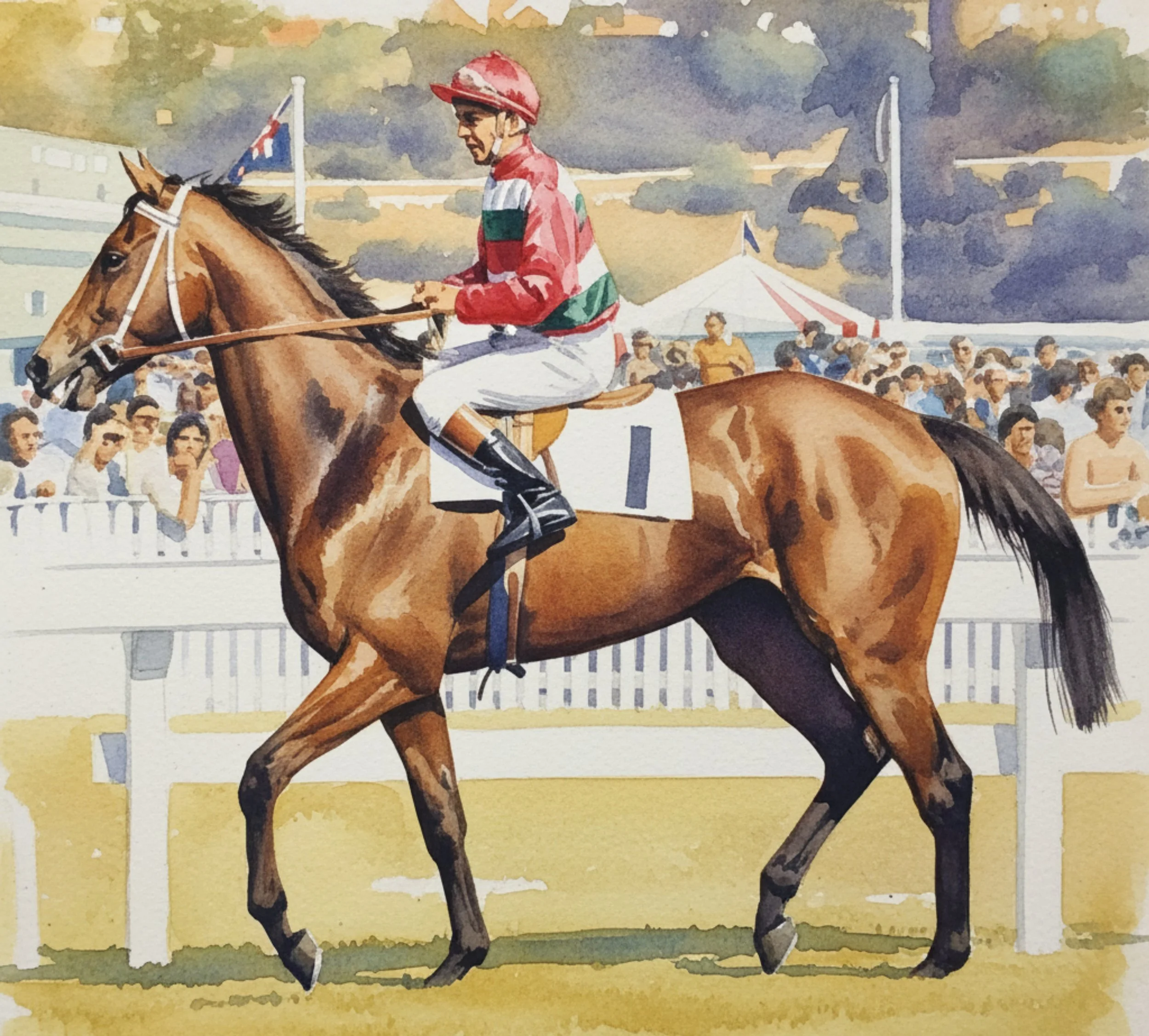
TARAS BULBA
Italian Jim Marconi was a man of many talents with a remarkable legacy and in Taras Bulba he found his first champion
Pioneer of thoroughbred breeding in the Matamata district, Jack Lindsay bred TARAS BULBA at Balcarres Stud. The purchaser, Italian immigrant Gilio (Jim) Marconi, was introduced to racing by his bricklaying workmates in Adelaide. The Italian master-builder had come to Australia from his native Verona seventeen years earlier for a brief stay with his older brother, Narciso. After selling his successful Melbourne bricklaying and marble-floor tiling business he engaged top Melbourne trainer George Hanlon to purchase a colt for him at the 1973 National Yearling Sale. He paid $13,500 which was a significant bloodstock price in 1973.
The two days of those sales at the at Trentham, in Wellington saw every record smashed and a staggering $3,173,500 paid for 382 horses. The aggregate and the average of $8,309 for both days completely eclipsed the previous year’s record. The colt, sired by ONCIDIUM and out of ENTRANCING BELLE (Bellbrough), was unfortunately misplaced for a period on a New Zealand wharf during his shipment to Melbourne. Upon its eventual reappearance, it appeared somewhat disheveled and emaciated due to the ordeal.
Registered as TARAS BULBA, the horse was turned out and gelded, with George Hanlon delaying his debut until early January at Sandown. TARA'S BULBA was not exported to Australia until he turned two, and his four starts in 1974 resulted in wins at Sandown and Caulfield and a fourth in the Gr.1 VRC Sire’s Produce Stakes behind SKYJACK.
At the age of three, he achieved a significant yet unexpected victory in Sydney, securing the Group 1 Rosehill Guineas with remarkable ease, under the expert guidance of jockey Gary Willetts. At odds of 20/1 on firm ground, Taras Bulba dealt to his opponents, winning by two lengths from DEFINATE and MANAWAPOI. He then started favourite in the Gr.1 AJC Derby, but Marconi had offered South Australian jockey John Stocker the ride which didn't sit well with Willetts. Despite getting worked up in the ring he won by half a length guided by Stocker who he must have felt a little fortuitous after a number of his main rivals were badly affected by inference in the big field, with one of those being DEFINATE flying home late for second.
Bypassing the Caulfield Cup to aim squarely at the Cox Plate - VRC Derby - Melbourne Cup treble, he looked the winner on the turn in the first assignment at Moonee Valley. All was going to plan before the iron horse BATTLE HEIGHTS rushed home from the back to get over the top of TARAS BULBA and win the 1974 WS Cox Plate. Hanlon pressed on to the Derby where he finished a poor 8th and the Cup for a disappointing 12th place finish.
George Hanlon successfully returned Taras Bulba to racing in the Hawkesburn Handicap at Caulfield, an open sprint covering 1200 metres, and unexpectedly secured a victory by a long neck, much to the surprise of bookmakers. A handicap win at Caulfield was followed by a third in the Tulloch Stakes. He then easily landed the delayed Gr.1 AJC Australasian Championship Stakes defeating the classy CAP D'ANTIBES and wrapped up the season with the Gr.2 VRC St Leger in record time on ANZAC Day. Few were denying him the status of best three-year-old of the season.
TARAS BULBA's four-year-old season commenced with an underwhelming performance, as the gelding secured only one victory in the Underwood Stakes across seven races during the late winter and early spring of 1975, culminating in a disappointing seventeenth-place finish behind THINK BIG in his second Melbourne Cup. Tommy Smith must have offered a fine sales pitch to Marconi in Melbourne for he transferred the horse to his stables which some considered an incredibly disloyal move. The disagreement between the owner and trainer was never fully resolved.
But T.J Smith was a master at bringing out the best in his horses and duly went about sprinkling the magic the following autumn with Taras Bulba, winning four major features in seven starts. Initially, the weight-for-age Queen's Plate and Queen Elizabeth Stakes were claimed at the Flemington carnival, after which the horse was transported to Sydney. There, he continued his impressive performance in set-weight races, securing victories in the Chipping Norton Stakes at Warwick Farm and the Queen Elizabeth Stakes at Randwick beating the great New Zealand champion BALMERINO.
Notably, between these two events, the horse delivered a remarkable front-running effort in the two-mile Sydney Cup, under the guidance of jockey Kevin Langby. In that race, Taras Bulba was narrowly overtaken in the final moments by the distinguished New Zealand stayer trained by Dave O'Sullivan in OOPIK, who was one year senior to Taras Bulba.
The autumn campaign marked the pinnacle of Taras Bulba's racing career. The initial vigor and performance instilled by Smith's training regimen had diminished by the horse's five-year-old season. Across seven starts, he was unable to secure a victory; notably, he experienced a bleeding incident in the 1976 W.S. Cox Plate, won by SURROUND, which resulted in an automatic three-month suspension. Upon Taras Bulba's return to racing in the Expressway Stakes at Randwick in mid-February, where he secured a second-place finish despite carrying 61kgs, it was subsequently determined that he had experienced a second bleeding attack. Consequently, the horse was issued a lifetime ban from all future racing activities within Australia.
Upon learning that chronic bleeders were permitted to race in the USA, Gilio Marconi made arrangements for Taras Bulba to be transferred to the stables of a prominent Californian trainer, Tom Doyle. During his two seasons in his new country, Taras Bulba competed in thirteen races, achieving only one victory, which occurred in an allowance race covering 8 ½ furlongs on the dirt at Hollywood Park. When he retired, Taras Bulba held the record as the highest stakes earner in Australasia with close to half a million dollars in earnings.
In 1976, aged 44 and with no experience handling horses, Marconi made the bold decision to move his young family into a 28-acre property at Moorooduc on the Mornington Peninsula with the goal of training. From here he would churn out winners for the next 40 years, including some of Victoria's best gallopers and stallions, starting from COSSACK PRINCE, RANCHO RULER, KING MARAUDING, SPARKY MISS right through to RAFFAELLO, who was the last winner he had.
RACE RECORD - AUS 53: 13-9-3
STAKE EARNINGS - $492,381
Rosehill Guineas
AJC Derby
Australasian Championship Stakes
VRC St Leger
Underwood Stakes
Queens Plate
Queen Elizabeth Stakes (Flemington)
Chipping Norton Stakes
Queen Elizabeth Stakes (Randwick)