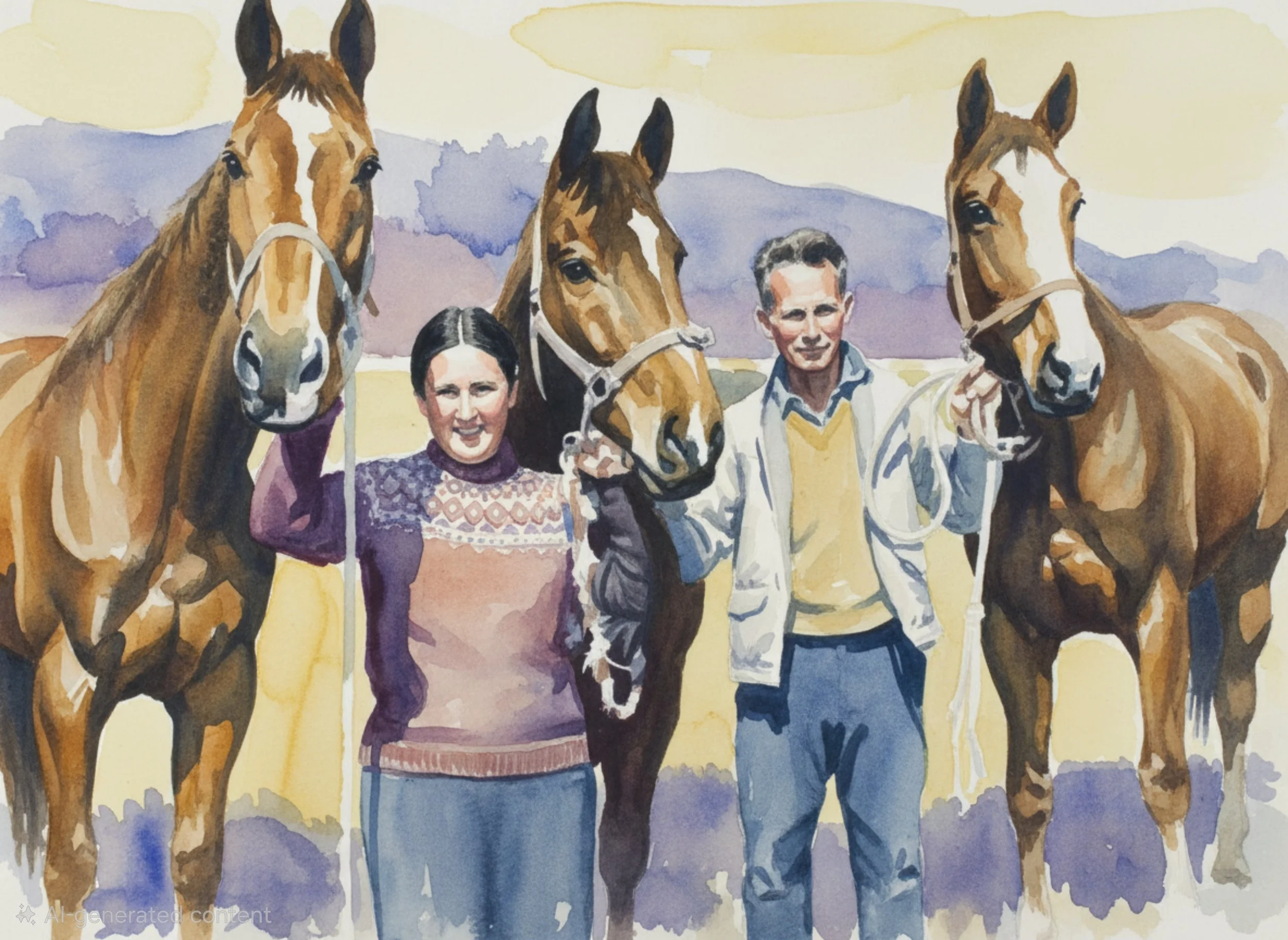
KEN & ANN BROWNE
KEN and ANN BROWNE were highly prominent figures in the New Zealand jumping community for more than four decades, with Ken initially training horses independently before Ann formally joined the partnership in 1983. With Kenny often riding, and Ann seeing to their needs, they were victorious in every feature jumps race in the country and proved to be a formidable presence at the Great Northern Steeplechase meeting at Ellerslie with their distinctive brown silks ringed with a single red hoop on both sleeves. They won nearly 800 races over the length and breth of New Zealand while becoming much loved members of the racing fraternity.
Ann Fraser spent her formative years on a farm situated off the East Coast of the North Island, where her family experienced a strong sense of community rather than isolation. The family resided on a farm located inland from Tikitiki, off the East Coast, before her father acquired a farm in Tirau, leading to their relocation to the Waikato region in 1953. Residing on the farm, they relied on horses for various tasks and actively participated in agricultural shows and sporting events held in the numerous small towns along the East Coast.
While her wider family's involvement initially piqued Ann's interest in the equine industry, her career in racing truly materialised following an introduction to her future husband, Ken Browne. Kenny and Ann's love story began at a hunt, sparked by a chance conversation and a shared connection through family and horses. Their whirlwind romance led to marriage at 20, two children by 22, and Ann was back in the saddle just weeks after welcoming their youngest son Roger. Initially, the number of racehorses under their care was limited; however, their acquisitions slowly increased, leading to a gradual expansion of stable operations. Mrs Browne recalls that many of the initial horses were either received as gifts or acquired at a modest cost, including CHOC WALLACE, a horse she holds in high regard.
Kenny and Ann initially commenced their endeavors with a limited number of horses, which were provided to Ken for evaluation due to various reasons and they acquired CHOC WALLACE for a meagre $230. He subsequently achieved significant winnings, notably a Waikato Hunt Cup. A fortnight later he secured victory in the prominent round-the-ring jump at the Waikato Show. Choc Wallace participated in shows during the summer and races in the winter, accumulating a total of 11 wins.
While the Browne's experienced success with several pre-owned horses, they ultimately chose to invest in their future by acquiring young stock directly from sales. Their strategy involved purchasing yearlings at a reasonable price, with Kenny and Ann collaborating seamlessly. Ann's role involved evaluating the horses outside the ring identifying suitable prospects, while Kenny managed the bidding process inside. The cost of the horse was not a primary concern, as their performance was not dependent on their purchase price. As a team they achieved a commendable success rate, with several horses excelling in flat races. Furthermore, they implemented a comprehensive training program to develop their jumping abilities from an early age.
The Browne family successfully trained the horses on their Cambridge property, employing a hill-based methodology that consistently yielded champion jumpers and numerous talented flat gallopers. Ann's extensive study and Ken's strong inclination for self-sufficiency were instrumental. Together, they synchronized ideas to develop their own unique approach. Previously, the practice of galloping horses at the Cambridge track was a time-intensive endeavor, however, with the acquisition of additional land, they were able to optimise the operations by training the horses in a more natural environment, leveraging the farm's resources.
This strategic shift significantly contributed to numerous racing victories. The land was equipped with logs and hills, and horses were trained to jump from an early stage and use the inclines to strengthen their bodies and build endurance. While some horses did not ultimately excel in the discipline, all participated in the training. Horses could demonstrate proficiency in jumping yet might not achieve success in competitive races due to limitations seeing out the staying distances. Many horses also found this to be a relaxing setting; those that arrived with some apprehension tended to acclimate and feel more relaxed and comfortable within their own skin.
Ken’s first major triumph as a trainer, owner and jockey came in the 1977 and 1979 Great Northern Steeplechase with ASCONA, and Ann got her name on the trophy as co-trainer for the first time in 1990 with ARDRI. Over the next 10 years, they won the Northern another five times, with the most memorable coming in 2001 with a dead-heat between their horse, SMART HUNTER, and Kevin O’Connor’s SIR AVION. Kenny Browne distinguished himself personally undertaking the roles of owner, trainer, farrier, and jockey; a comprehensive engagement that solidified his reputation as "King Kenny." He rode 156 jumps winners in New Zealand, 102 of which were over steeplechases. The last steeplechase win came as a 67-year-old in 2001. As co-trainers, they would would go on to produce great jumpers, such as CROWN STAR, BROTHER BART. TOM’S MYTH, LORD TENNYSON, DROPS O’RAIN WANDERLUST, CIVIL RIGHTS, DROPS O'RAIN, SYDNEY JONES, IMA WONDER and SMART HUNTER among many.
Prior to the iconic 2001 Ellerslie event, Ken experienced a severe injury from a fall schooling a horse on their Cambridge property. He remained hospitalised when Smart Hunter secured victory in the Great Northern Hurdles on the Saturday. He had intended for Smart Hunter to compete in both races. Understanding this, Ann proceeded with the plan, and achieving a dead heat in the steeplechase was a truly remarkable result.
As a team they consistently identified horses with significant potential as undervalued gallopers and were fortunate to have highly skilled riders to work with. In 2004, WANDERLUST would deliver the Browne's final Northern victory prior to Ken’s passing in 2006, but Ann would continue their legacy, adding another three more Northern crowns, with FAIR KING (2009), IMA HEROINE (2011) and TOM’S MYTH (2012), with the latter becoming the first horse to win a Wellington Steeplechase, Pakuranga Hunt Cup and Great Northern in the same season.
FAIR KING and IMA HEROINE represent a select group of horses bred by the Browne family, with Kenny's background in polo serving as a catalyst for their modest breeding endeavors. Ken rode a mare named MISS LUCA, who possessed the requisite physical attributes for polo and a lineage indicative of producing successful jumpers, a fact substantiated by her offspring. He acquired her and she produced a foal with their polo pony stallion, MOKOWAI, and subsequently had two foals sired by NORTH POLE aligning with the scale of their breeding operation. The subsequent generation included Great Northern winner Ima Heroine and Ima Wonder, who triumphed in the Pakuranga Hunt Cup.
Following the NORTH POLE venture, they opted not to breed their own stallions, instead utilising external stallions for several breeding’s, ultimately acquiring HEROICITY, who subsequently relocated to America. While Ken achieved numerous victories with their horses over the years, Ann Browne found fulfillment in her work with horses at home, attending races, and managing the administrative aspects of both their farm and racing operations. Ann meticulously maintained comprehensive records dating back to 1983, detailing each horse, race, and jockey. Her responsibilities also encompassed accounting functions, including bill payments and the management of sheep and cattle.
During races, she would lead the horses, with Kenny serving as the jockey. In instances where they had multiple entries, additional riders were engaged, all of whom were personal acquaintances. This collaborative spirit is characteristic of the jumping community; while competition is inherent, there's a shared desire for success among peers.
Ann consistently took pride in the appearance of their horses at races, despite their living in a paddock with other horses rather than being stabled. Consequently, they often arrived at the races covered in mud, necessitating thorough cleaning to ensure their impeccable presentation. Mrs Browne upheld this same standard of presentation and performance with her horses until her retirement from training in 2018, having achieved 626 domestic wins, 43 of which were at stakes level.
Ken and Ann Browne will always be remembered as absolute stalwarts in the jumps racing scene, creating a legacy for others to follow with the same desire and passion. Ken Browne amassed an almost unmatched record as a jockey and trainer of steeplechasers and hurdle horses. His contribution to racing was recognised with an MBE in 1991. Ken served a three-year term on the executive of the New Zealand Racing Conference and from 1984 to 1987 was president of the Waikato Racing Club, which later made him a Life Member. Ken was also inducted into the New Zealand Racing Hall of Fame. Ken and Ann Browne, are widely recognised as key racing industry figures warmly admired within New Zealand's racing and jumping community.
Great Northern Hurdles - three times: SALAZAR, GOLD STORY, SMART HUNTER
Great Northern Steeplechase – a record 12 times: ASCONA (twice), ARDRI, BROTHER BART, LORD TENNYSON, SYDNEY JONES (twice), SMART HUNTER (dead-heat), WANDERLUST, FAIR KING, IMA HEROINE, TOM’S MYTH
Pakuranga Hunt Cup – 10 times: ARDRI, KUTATI POWER, EXTRA TIME, SYDNEY JONES (twice), DROPS O’RAIN, WANDERLUST (twice), TOM'S MYTH, IMA WONDER
McGregor Grant Steeplechase – 8 times: CIVIL RIGHTS, EXTRA TIME, SYDNEY JONES (twice), WANA, ALL RHYTHM, KIA KING, PRIMO CANERA
Riddiford Steeplechase – 6 times: CHOC WALLACE, THE OPERATOR, CROWN STAR, ARDRI, INJUN JOE, MOSSY RIDGE
Grand National Steeplechase – 4 times: REGAL MINK, CHARLESTOWN, CROWN STAR (twice)
Wellington Steeplechase – 3 times: ROYAL HUSH, FLASH HUNTER, TOM’S MYTH
Waikato Steeplechase – 3 times: CROWN STAR, TRELAY BOY, DROPS O'RAIN
Grand National Hurdles – twice: DARK PURPLE, CROWN STAR
Read about the incredible SMART HUNTER v SIR AVION deadheat in our dedicated story https://www.downunderpunter.com/smart-hunter-v-sir-avion?rq=Smart