GLOAMING
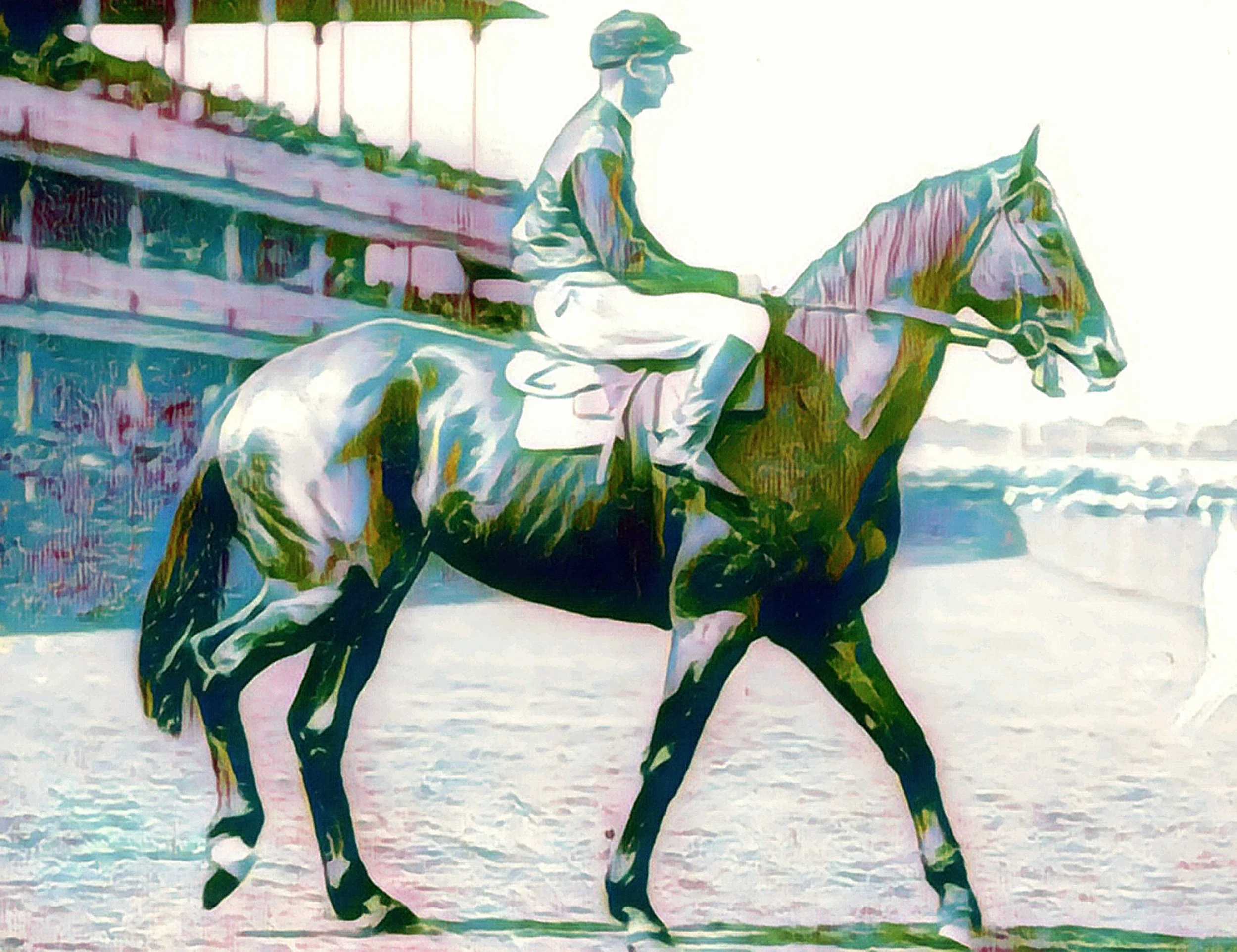
He was clunky, angular and more carthorse than racehorse, but his bulk mattered little
GLOAMING was an outstanding Thoroughbred racehorse, owned, trained, and based in New Zealand. He set many records which included the Australasian record (that he jointly held with DESERT GOLD) of 19 plus successive metro wins, many in Principal Races. Gloaming was unusual in that he was a champion who won many major races in both Australia and New Zealand. Gloaming still holds the Australasian record of 45 seconds for four furlongs, (804m). He was a robust bay gelding standing 15 hands 3 inches high, a solid horse with a good length of rein and a stride capable of covering 25ft (7.62m).
Gloaming was sired by the good imported racehorse and sire, THE WELKIN (GB) out of the unplaced mare, LIGHT (GB), who was by the good sire, EAGER. His paternal grandsire was the English Triple Crown champion, FLYING FOX. Gloaming was sold as a yearling in 1916 for 230 guineas to H. Chisholm acting on behalf of George D. Greenwood, of Teviotdale in the Canterbury region of New Zealand. Following the sale he made his first of 15 crossings of the Tasman Sea, often aboard the vessel, the Ulimaroa, and he was a devout traveller of over 35,000 miles in the name of racing.
Unraced as a two-year old, GLOAMING commenced his career by winning the 1918 WFA Chelmsford Stakes at Randwick by eight lengths in record time. Dick Mason had taken the precaution of entering the horse in both the Novice and the Chelmsford Stakes run on the same card. Reports of Gloaming’s talent had reached the club’s handicapper, for in the Novice he allocated the gelding ten pounds more than his stablemate, MOLYNEUX, and yet both were unraced three-year-olds. However, the issue became academic when Mason chose to scratch Gloaming from the Novice and elected instead for a baptism of fire against the best weight-for-age horses in the land.
The cat had already been let out of the bag when the big and robust bay gelding beat his more illustrious stablemate in a track gallop at Randwick some weeks earlier. The touts might not have known the respective saddle weights the two horses carried in the gallop or how lightly each was shod, but it was clear this newcomer knew how to put his feet down. Into the straight, all sorts of runners were being hailed as the likely winner until the white-faced bay horse shot into view on the outside. Gloaming won running away by eight lengths in Australasian record time, clipping a quarter-second off the previous record
Everybody now wanted to back Gloaming for the Derby although there remained certain sceptical pressmen who warned that the Chelmsford form might prove misleading. After all, Gloaming was by The Welkin, and his progeny thus far had proven largely to be sprinters and milers. The estimated attendance on Derby Day was 60,000 people, a record crowd and yet another reminder of just how little the War had affected racing in New South Wales. GLOAMING served it up from the front in a quick time, defying all challengers to run him down.
The clock told the tale: Gloaming recorded 2 minutes 33 ½ seconds for the Randwick mile and a half, only a second worse than the race record. The Derby was a triumph for the Dominion and, for the third year in succession a New Zealand invader had taken the prize. Gloaming might have been bred in Australia, but this was little comfort in a race where the first five place-getters all hailed from across the Tasman Sea. From 1919 to 1921 he won 19 races in succession, equalling the Australasian record of Desert Gold. Gloaming had a long career, racing from age three to nine years, which included victories over other champion racehorses such as the brilliant DESERT GOLD, BEAUFORT, KENNAQUHAIR, WHITTIER and THE HAWK.
Gloaming’s triumph on Derby Day at Randwick was merely the prelude to a glittering career on the Turf. He returned to New Zealand without a further appearance in Australia, before Gloaming came out a month later to win the New Zealand Derby at Christchurch, and in the summer, he added the Great Northern Derby at Ellerslie. He raced 16 times in his first season, recording 13 wins and 2 seconds. SASANOF beat him in the Stead Memorial, while DESERT GOLD beat him a neck in the Taranaki Stakes. The gelding and the mare clashed five times in total, and this was the only occasion Desert Gold defeated thim.
At four, Gloaming again competed at the A.J.C. Spring Meeting. He suffered his only loss in seven starts that season when POITREL beat him by a head in the Spring Stakes on the first day, but later on at the meeting he won the rich Craven Plate. Gloaming crossed the Tasman again to compete at the A.J.C. Spring Meeting, but one morning after a track gallop at Randwick, the horse bled profusely from both nostrils. Gloaming returned to New Zealand without starting in Australia. It was a shame because his form later that season in New Zealand suggested he was at the very peak of his ability. Contesting a dozen races ranging in distances, from four furlongs to a mile and a half, he won them all.
In the spring of 1922, the seven-year-old engaged in a series of four legendary match races with his arch rival, BEAUFORD; the score being two wins each. At the time of their clashes, Gloaming was seven and Beauford six, and each carried the same weight. These epic encounters captured the public imagination as never before. Gloaming squared the series on the third day of the meeting with a convincing win in the Craven Plate, their fourth and final race. It was quite noticeable on the day how many of the crowd left the racecourse immediately after that contest, but it did take plenty out of both horses. The wonder horse came across to Sydney again for the spring the following year but developed a joint problem that saw him return to the Dominion for a third time without racing. The problem was enough to keep him off the scene until January 1924.
However, when he did come back to Australia, he won four of his five races as an eight-year-old and should have won them all. For a horse whose name meant twilight, Gloaming lived up to it by raging against the dying of the light to the very end. Even as a nine-year-old, he won eight of his ten starts, indeed his last eight races in succession and in the other two, coming at the very opening of his 1924 spring campaign in Sydney, he ran second in each. Those victories consisted of the Spring Stakes as well as a third Craven Plate at the A.J.C. Spring Meeting where the old champion was received with rapturous acclaim.
As a nine-year-old Gloaming was still a top performer, winning eight of his ten starts. In his swan song at the age of ten, Gloaming beat the latest Kiwi champion, THE HAWK, in the Ormond Gold Cup at Hawkes Bay. It wasn’t intended to be his last race, but that troublesome joint made him impossible to train thereafter. He was successful at distances from four furlongs to a mile and a half. From 1918 until 1926, he won 57 races from 67-lifetime starts. Gloaming was runner-up nine times, leaving just one thorough defeat, and that occurred in the North Island Challenge Stakes of 1919 when he fell while entangled in the barrier tape.
Throughout the history of racing in Australasia, the wealth and dominance of Australian buyers and breeders have so often seen so many of the best New Zealand racehorses either bought as yearlings or as older, tried horses, which were then transported across the Tasman to be raced exclusively in the land of Oz and effectively becoming part of that country’s sporting and cultural narrative. Gloaming is perhaps the best example of a horse that bucked that trend. Bred in Australia, he was bought by a New Zealand sportsman, and while he raced extensively in both countries, he regularly and successfully raided the A.J.C. Spring Meetings. Greenwood observed: “Gloaming doesn’t belong to me; he belongs to the people.”
GLOAMING was retired in 1926 as the greatest money-spinner in Australasia. He had eclipsed CARBINE (NZ) and EURYTHMIC in that respect, and he lived out his days on good grass at Teviotdale, sharing a fence with the stallion SUTALA (NZ). In 1928, Greenwood’s wife published Gloaming: The Wonder Horse, a copy of which was accepted by King George V in England, and on May 5, 1932, the great old gelding died at home. Gloaming succumbed to an inflammation of the stomach, and a week to the day later, his trainer, Dick Mason, followed his great horse into the afterlife at 79 years of age. His list of victories are too immense to mention, but he won most major features on both sides of the Tasman making him close to the greatest ever produced in New Zealand.
RACE RECORD - 67: 57-9-0
EARNINGS - £43,100
Chelmsford Stakes (1918)
AJC Derby (1918)
New Zealand Derby (1918)
Wanganui Guineas (1918)
Great Northern Derby (1919)
ARC Islington Plate (1918, 1919, 1920)
WRC Wellington Stakes (1919)
Wanganui Jackson Stakes (1919,1921, 1922, 1924)
North Island Challenge Stakes (1922, 1924, 1925)
Craven Plate (1919, 1922, 1924)
Hill Stakes (1922)
Ormond Memorial Gold Cup (1922, 1925)
Melbourne Stakes (1924)
AJC Spring Stakes (1924)
Australian Racing Hall of Fame
New Zealand Racing Hall of Fame (2006)
Gloaming Stakes run at Rosehill Racecourse