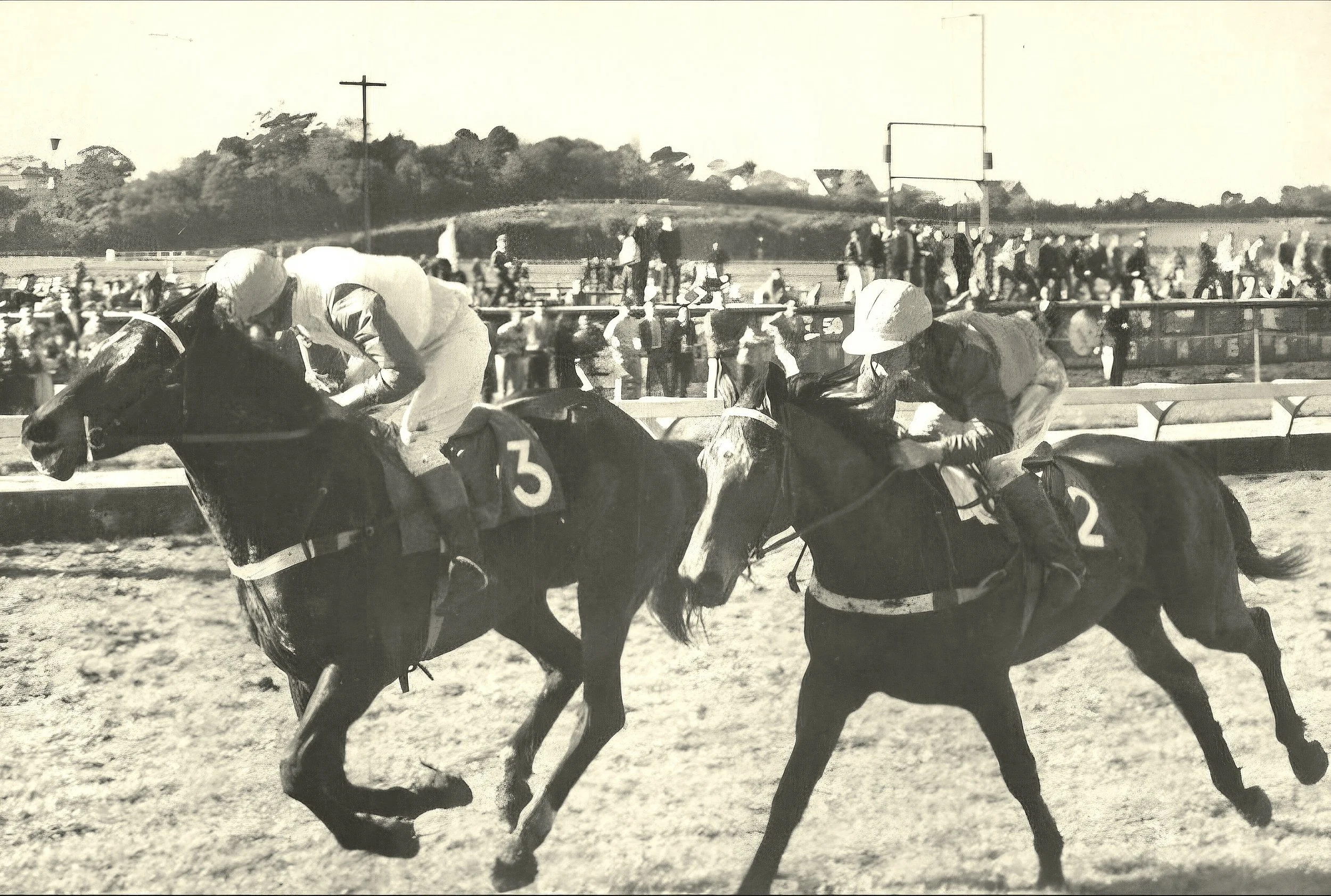
EIFFEL TOWER
EIFFEL TOWER took a wrong turn, then proceeded to stage one of the greatest comebacks ever witnessed to win the 1967 Great Northern Steeplechase
The esteemed New Zealand thoroughbred racehorse, EIFFEL TOWER, is renowned for achieving one of the most extraordinary comebacks in racing history. This remarkable feat occurred when the horse triumphed in the 1967 Great Northern Steeplechase, despite initially taking a wrong turn and falling 50 lengths behind the leaders. Owner Bill Hazlett, affectionately known as "Big Bill," possessed a profound enthusiasm for racing, particularly steeplechasing, and made significant contributions across diverse domains. Hazlett went on to be the dominant owner of the 1960s, however, the collaboration between Hazlett and Bill Hillis proved exceptionally fruitful, yielding a remarkable cohort of champion jumpers, most notably Eiffel Tower, who was unequivocally the leading stable star of the era racing in the famous white colours with green sleeves.
WILLIAM EDGAR HAZLETT was a prominent figure in the agricultural, thoroughbred breeding, and racing sectors of Southland for over three decades. Hazlett's exceptional physical prowess and unwavering resolve quickly established him as a prominent figure in the sport of rugby. At the age of 19, he represented Southland, and in 1926, he was selected for the All Blacks team that toured Australia. He was a loose forward, big and fast, standing at six feet tall and weighing 15 stone. He distinguished himself as the preeminent forward during the challenging South African tour of 1928 and subsequently competed against the British Iles touring team in 1930.
Upon the passing of his brother in 1944 and his father in 1947, Hazlett assumed ownership of Burwood, Mavora, and Centre Hill Stations in Northern Southland, encompassing a total of 134,133 acres. Additionally, he acquired the Chelandry thoroughbred stud, located in Taramoa near Invercargill, which had been established by his father in 1918. Bill Hazlett maintained his father's engagement in the breeding and racing of thoroughbred horses, initially collaborating with his brother, Jack who was sadly killed in Italy in WWII. He achieved the position of runner-up in the New Zealand trainers' championship during the 1946-47 and 1948-49 seasons and was recognised as the most successful owner in the 1941-42 season. In 1959, W. J. Hillis, who had been affiliated with the stable since 1945, assumed the role of trainer. This appointment heralded another era of significant achievement. For five consecutive seasons, commencing from 1964-65, Hazlett was acknowledged as New Zealand's foremost owner, producing a host of champions.
Hazlett bred and trained his horses to be tough and versatile, capable of winning at any distance. Never afraid of adopting an innovative practice, Hazlett trained his horses to jump at an early age; they were entered in hurdle and steeplechase races when in their prime for flat racing. An outstanding product of this regime was the robust stayer Eiffel Tower. The Hazlett stable, often with Hillis riding, won all the major races on the New Zealand jumping calendar as well as many important flat races.
Most of Hazlett's racehorses were bred at the Chelandry stud, where grey thoroughbred stallion KURDISTAN sired a 25/1 Melbourne Cup winner in BAGHDAD NOTE, as well as such famous horses such as KUMAI, KORAL, JOHN O'GROATS and EIFFEL TOWER. Kurdistan's fillies were also sought-after as brood mares. In 1966 Hazlett paid a New Zealand record price for the English galloper LOMOND; the horse sired a string of winners, including LOCH LINNHE, winner of the Australian Grand National Steeplechase, 1974 Grand National at Riccarton and dual Great Northern victories in 1975 and 1976. He won a hurdle at Trentham as a four-year-old in his jumping debut and had an outstanding record as a steeplechaser, with 11 wins from 18 attempts.
KORAL was near unbeatable around 4000m but found the extreme distance of the Grand National and Great Northern against him, especially as he was invariably carrying big weights. However, he still has a special place in Grand National Steeplechase history, as the youngest winner a week into his five-year-old season; a notable achievement in a race that has been run since 1875. In all, he won 25 races over fences – an astonishing number - and at the time of his retirement, in 1972, had won more money as a jumper than any other New Zealand horse.
EIFFEL TOWER was no slug on the flat winning the 1965 Wellington Cup ridden by Midge Didham who served his apprenticeship with Bill Hazlett Snr. The young jockey was able to ride extremely light in his early days and the bonus was he could pick up lightweight mounts, but he had to get on horses he could manage. He rates Eiffel Tower the best horse he has ridden and carried 46.5kg during his victory in the Wellington Cup. The following year, Eiffel Tower competed in the Wellington Cup again, taking the lead in the straight before being overtaken by RED CREST. He had missed a lead up racing through injury which didn't help his condition. Eiffel Tower did win the hometown 1965 Invercargill Cup, a race Midge won on APATHY the year before in 1964.
BILL HILLIS and his nephew BRIAN "Baggy" HILLIS were master jumps jockeys, with Billy holding sway in the south and Baggy in the north. Neither were fine stylists, but they were brilliant horsemen. Hazlett eventually handed over the training duties to Bill Hillis, who twice won the national premiership from his Riverton base in the 1960s, when private trainer for Hazlett. Moving that partnership to the Southland base would reap rewards. Bill schooled them and rode them too; he was a man who got out there and did it all from feeding to kicking them home.
EIFFEL TOWER won the Grand National Hurdles twice in 1966 and 1967 and ten races on the flat, including the Wellington Cup, but will always be best remembered for his victory in the 1967 Great Northern Steeplechase, which is still rated as one of the most spectacular performances in the history of the famous race.
Most punters on course were ready to tear up their tote tickets when EIFFEL TOWER ran off at the seventh fence which just so happeed to be the water jump and seemed to lose his way before Bill could regather the reins. The southern visitor had suddenly veered left unsettling big grey KUMAI who stumbled and threw his rider, with Eiffel Tower losing around 50 lengths in the mayhem.
EIFFEL TOWER had headed between two further jumps and now out of touch with the field. He was a fence behind his rivals by the time Bill Hillis had turned him back and rejoined the race, thankfully not missing a hazard. Hillis calmly regained control of his mount and resumed the race a long way off leading contenders but set off in pursuit knowing EIFFEL TOWER had the pace on the flat, strong staying ability and sound jumping technique as an adept hurdler.
Remarkably, Eiffel Tower, who had been steadily overtaking tiring competitors one-by-one, found himself in the lead when CALM LAD fell at the summit of the hill on the final circuit. What initially appeared to be a symbolic effort by Hillis transformed as Eiffel Tower had progressively closed the gap, ultimately gaining the lead at the top of the rise. Amidst the resounding cheers of an astonished crowd, Eiffel Tower powered up late to triumph, securing a victory by half a length over 12-year-old RINGLOCK in one of the most extraordinary demonstrations of resilience and endurance ever witnessed in New Zealand racing.
Those who were there that day still speak of Eiffel Tower powering ahead to win the grueling steeplechase by half a length, etching his name into racing folklore. Hazlett would win the Great Western Steeplechase an incredible 16 times and die suddenly while dog trialing, which was his other great passion. Bill Hillis trained nine winners of the Riverton Cup, from 1963 to 1981 and recorded 10 training and riding wins in the Great Western Steeplechase. KURDISTAN's bloodlines are deeply woven into New Zealand's equestrian history, heavily influencing top Grand Prix show jumpers and Olympic eventers, but the feats of his great racing son EIFFEL TOWER at Ellerslie that day will never be forgotten.