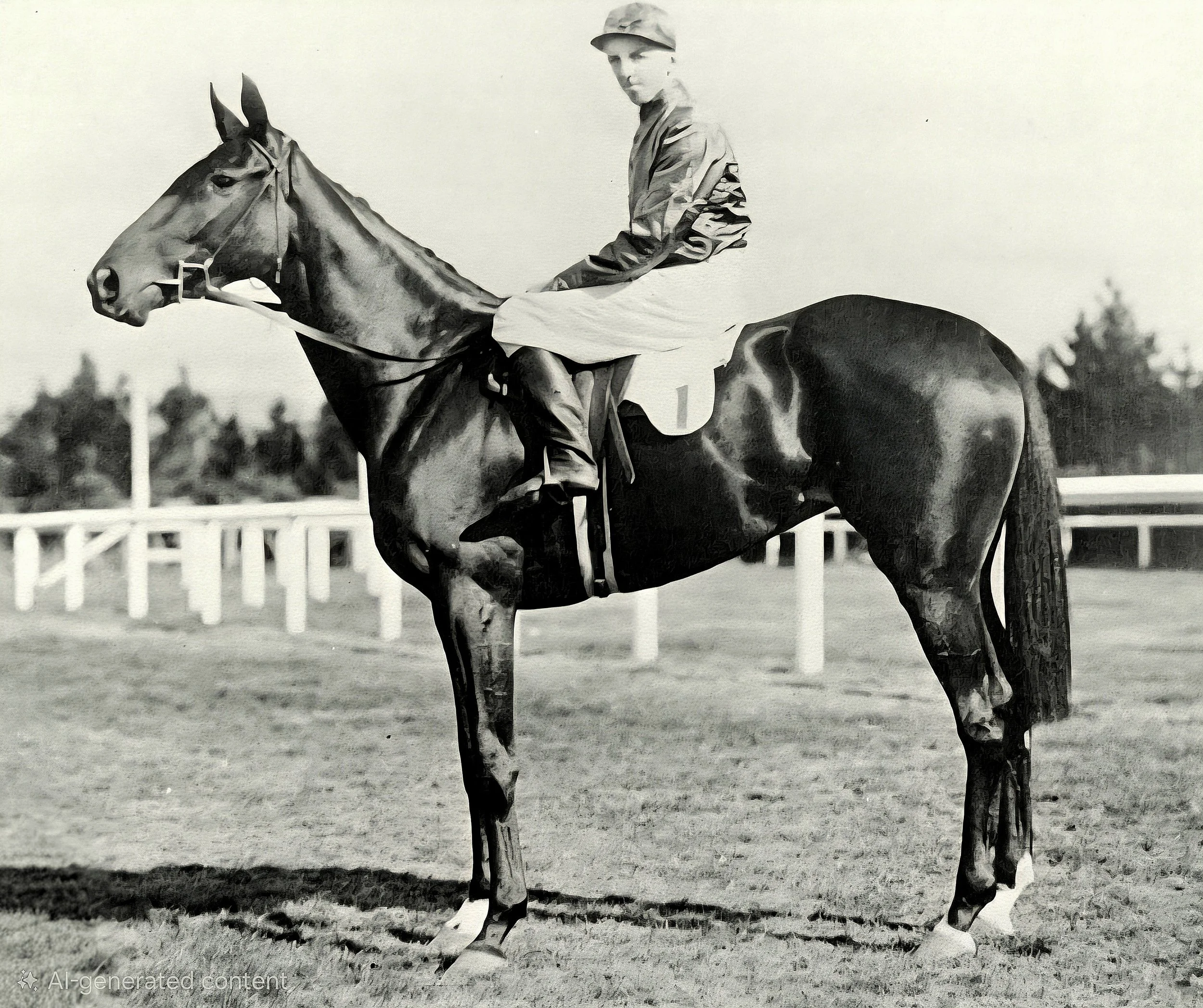
DESERT GOLD
The first lady of the New Zealand turf was nothing short of brilliant in a time of war
In the early days of the First World War, New Zealander's looked to the turf to lift their spirits and the exploits of one exceptional racehorse. The renowned and triumphant New Zealand thoroughbred, DESERT GOLD, graced the racing scene during the difficult era of World War I. As valiant young men answered the call to serve and embarked on the arduous journey to Europe in 1915, this exceptional filly had already commenced her illustrious reign. Desert Gold was a true Hawke’s Bay champion - foaled in Hawke’s Bay, owned in Hawke’s Bay, bred and raced and trained in Hawke’s Bay.
Arguably, DESERT GOLD (1914), together with the gelding, GLOAMING (1915), and the colt, EURYTHMIC (1916), were the superstars of this period - as their Hall Of Fame status indicates. She was the first NZ thoroughbred to chalk up a record of 19 consecutive wins while racing against colts, as well as fillies, in both NZ and AUS. Desert Gold ran during the dark days of WWI and her courage lifted the hearts of her racing public. She brought people to the track to forget their worries.
Her front running style and fierce determination thrilled race fans in Australia and New Zealand, winning 36 races, including those 19 in succession. She was owned by Tom Lowry and trained by Fred Davis for whom she won many good races. Desert Gold was by the brown sire ALL BLACK (GB) (1904) by the chestnut dam, AURARIUS (AUS) (1905) and bred not far from Hawkes Bay. The Lowry name would breed horses from their Okawa base for generations to come. Tom Lowry was a very wealthy man in his day, and he had this interest in horse racing, so he could provide the best environment for good racehorses. In Desert Gold they had a long legged filly that was beautifully built for speed.
In 1914, she won the Great Northern Foal Stakes and Royal Stakes, the Manawatu Sires Produce Stakes (in race record time) and the North Island Challenge Stakes, demonstrating the emergence of a seriously formidable contender. Desert Gold had 14 starts and won all of them, five of them in race record time - a win record that stood for 30 years in New Zealand until beaten by MAINBRACE. As four-year-old Desert Gold had seven starts and won five of them and was second and third in the other two races.
An indication of her abilty was when the mare beat SANSANOF at Ellerslie less then two months after he won the 1916 Melbourne Cup. Sasanof was at his peak, but Desert Gold defeated him comfortably. Possibly, the long journey home had taken a toll on Sansanof, but there was no doubting his class. Desert Gold had 13 starts as a five-year-old and won nine of them, and was second in two and third in the other two races. She was beaten on a heavy track at Hastings by a 2yo horse carrying 38lbs (17kg) less. Jockey Jacko O'Shea also accused the winning rider of pulling his reins early on in the race which hindered her chances significantly.
In those days, to get a horse to Australia, you went by train down to Wellington, lugged up onto a steamship, sailed to Sydney for four days – and then you came all the way down again on the train to get to Melbourne, to Flemington and Caulfield. The Australian reporters were anxiously waiting to observe Desert Gold coming out of her carriage onto the station; and while the other horses are kicking and snorting and carrying on in the usual temperamental way that thoroughbreds do, the doors opened and Desert Gold walks out onto the platform in front of all the reporters and looks around calm and steady, ears pricked up with total poise.
As six-year-old Desert Gold had 10 race starts for 2 wins and 5 seconds. She was allotted a handicap weight of 9 stone 6 pounds (60kg) in the Melbourne Cup but was unplaced to the winner, NIGHT WATCH, who carried 6 stone 9 pounds (42kg). As topweight and with serious interference the mare never really stood a chance. The mare was so popular by now that even big tobacco companies wanted her for endorsements. The National Tobacco Company at Ahuriri, Napier produced Desert Gold tobacco with collectable cards, and there was also Desert Gold tea, marketed as the ‘Queen of Teas’.
The War ended, but a new challanger was on the horizon and ready to take her mantle. The champions met in three match races in Taranaki in 1919. Her only principal win that season was when she defeated the star three-year-old colt, GLOAMING in the 1919 Taranaki Stakes, with Hector Gray kicking the mare home in record time. In her final season of racing, Desert Gold had three starts for a third in the G.G. Stead Memorial Stakes which were won by Gloaming.
In 1918-1919, the second trip to Australia wasn’t such a roaring success. Desert Gold and Brusher Gray were literally trapped over in Sydney Australia because of the the 1918 influenza epidemic, known as Spanish flu. It was rampant in New Zealand; in Australia it wasn’t so rampant because they implemented a quarantine system on the shipping. Along comes this guy, Beaumont Smith – a bit of an entrepreneur. He made a silent movie called ‘Desert Gold’, starring none other than the horse herself. Desert Gold had a plane zooming in; it had the goodie, the baddie, the woman, the romance and the outback scenes which were filmed on some scraggy bit of land in Sydney. The lady actress actually fell off her horse and broke her arm. The movie ends with a horse race down the track. The jockeys Jack O’Shea and Mitch McLaughlin from Australia rode the her in the final scene. There was a big fire in Melbourne in 1925, and like a lot of silent movies, it was lost forever. It did bring in the crowds though when first shown at the Globe theatre in Auckland.
At Awapuni they jacked up this race between BIPLANE, who was the top Australian horse in 1917, and Desert Gold, who was at the peak of her form. This race between these two foes was to happen and it created a huge amount of interest. The night before the race, Biplane was sensationally scratched, basically because the owner knew that Desert Gold was going to trash him. There was an uproar about this whole thing, because people had come from all over Australia, New Zealand to Palmerston North to see this race. Apparently carloads of people were driving round Palmerston North trying to find accommodation, but the match race never happened.
They roared before the race, they roared during the race; and when Desert Gold won the race and was brought back to receive the Awapuni Gold Cup, Tom Lowry was up on the shoulders of people, and there was a ring of policemen holding back the crowd around Desert Gold. The gentle mare just walked back into the birdcage calm as ever without a hair out of place. The newspaper reporters said, “The air was electric”; almost a sort of mystical thing about Desert Gold – that was the popularity behind this horse.
Jockey, Jack O’Shea, a mild mannered man unfortunately got pneumonia in 1925 at the races at Dannevirke and died. But he was the top jockey who, if you look at that record of nineteen wins, he was the key man in her success alongside Tom Lowry and Fred Davis. But also ‘Brusher’ Gray, the groomer who had a huge amount of responsibility keeping an eye on such a valuable animal. Brusher went out on his own to be a private trainer and trained HIGH COURT to win a Hawkes Bay Cup.
DESERT GOLD was a champion not only for New Zealand but for all of Australasia. Her race earnings of £23,000 were a record that remained unbroken until after the Second World War. But the other key record she created in Australasia was winning nineteen races in a row at the higest level on metropolitan tracks, and that was only beaten by BLACK CAVIAR in 2012, so it’s a record she had along with GLOAMING; Gloaming’ equalled it, but they both held that record for a long, long time. So between 1st of May 1915 to 10th April 1917 she just won race after race and the public loved her; she was a winner.
DESERT GOLD was retired and returned to Okawa Stud, becoming a successful broodmare that produced a total of nine foals, of which six raced and three were winners. Her offspring went on to produce fine competitors; 1922 filly, OREUM by King John (IRE), dam of the brilliant GOLD ROD, won 14 stakes races including AJC Epsom Handicap and AJC Doncaster Handicap - 1925 filly, PURE GOLD by Psychology (GB), dam of GOLD TRAIL (won Auckland Cup) - 1928 filly, SAHARA by Grandcourt (GB), dam of stakes winner, KARACHI and others.
Several races have been named after her in New Zealand, including the time-honoured Group III Desert Gold Stakes (1600m) at Trentham Racecourse. In 2008 she was inducted into the NZ Racing Hall of Fame alongside TULLOCH, MAINBRACE, BALMERINO, RISING FAST, FOXBRIDGE and SIR TRISTRAM.
RACE RECORD - 59: 36-13-4
EARNINGS - £23,239
Great Northern Foal Stakes (1914)
Royal Stakes (1915, 1916)
Islington Plate (1915, 1916, 1917)
Hawke's Bay Guineas (1915)
New Zealand 1000 Guineas (1915)
Manawatu Sires Produce Stakes (1915)
Great Northern St. Leger (1916)
Awapuni Gold Cup (1916, 1917, 1918)
CJC New Zealand Derby Stakes (1915)
Great Northern Derby (1916)
New Zealand Oaks (1916)
Wellington Stakes (1916)
VATC St George Stakes (1918)
AJC All-Aged Stakes (1918)
Taranaki Stakes (1919)