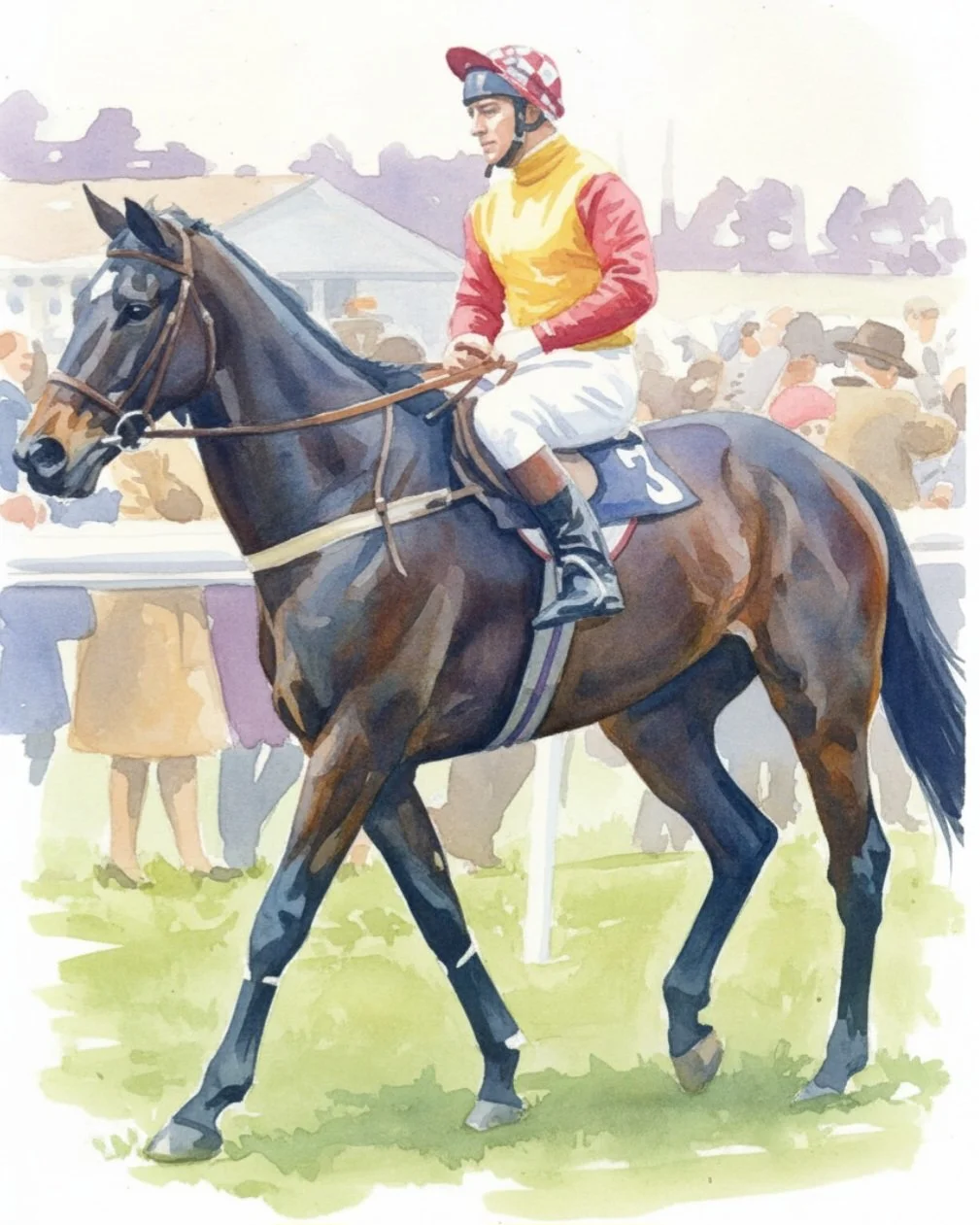
CRISP
Crisp was an exceptional steeplechaser and is arguably one of the preeminent jumpers that have competed over the big steeplechase obstacles
CRISP was an Australian-bred, and subsequently British-trained, steeplechase horse of exceptional calibre. He was a bay Thoroughbred gelding, foaled in Australia in 1963. In his native country guided by trainer Des Judd, Crisp won many important jumping races, particularly two-miler events, including the Hiskens Steeplechase in 1969 and 1970. Crisp was bred and owned by VRC Chairman, Sir Chester Manifold.
As a two and three-year-old he showed only limited ability on the flat, and his future was in doubt. At four and five he turned to hurdling and won five races. Switched to steeple chasing, he finished the 1968/69 season with wins in the Red leap and Hiskens Steeplechases, the latter by 20 lengths. The following season he repeated his Hiskens win, this time by 12 lengths in course record time.
So talented over the jumps, he was nicknamed "The Black Kangaroo". However, Crisp is probably best remembered for his epic contest with Red Rum in the 1973 Grand National in England.
The large, nearly black bay, a descendant of ROSE ARGENT, was an exceptional steeplechaser and is arguably considered the preeminent jumper among all horses that have competed over the big obstacles. Tom McGinley who was his regular rider in Australia enjoyed a stellar career as a leading jumps jockey in after emigrating from Scotland in 1965.Tom is the only jumps hoop to win five VRC Grand National Steeplechases and is better known as the man who partnered the mighty chaser.
In 1969, during the Melbourne Cup Steeple, Crisp was leading the field. As Crisp approached a fence in the steeplechase lane, directly opposite a densely populated Hill Stand, he initiated his jump a stride prematurely. A collective gasp emanated from the thousands of spectators as a fall seemed imminent. However, Crisp miraculously cleared the obstacle, eliciting a thunderous cheer from the crowd upon his safe landing. He then galloped on to secure another remarkable victory.
Eventually Crisp was weighted out of races in Australia, so his owner Chester Manifold, who incidentally was the driving force behind the establishment of the TAB in 1961, decided to race him in England. And he went to the best. Fred Winter had carved out a hugely successful career as a jumps jockey - he won four jumping titles plus two Grand Nationals and two Cheltenham Gold Cups - and produced two Grand National winners in his first three years as a trainer. He went on to win eight training titles.
CRISP made his British debut in a handicap race at Wincanton and was allotted 12 stone 7lbs (79kg). He was ridden by Richard Pitman, who would go on to ride Crisp for the rest of his racing life. Crisp won his debut race easily, by 15 lengths. His first major test was the 1971 Champion Chase at the Cheltenham Festival (now the Queen Mother Champion Chase). Once again, it was an easy victory. The following year, Crisp's owner decided to run him in the Cheltenham Gold Cup. But the two-miler struggled in the three-and-a-quarter mile race, finishing fifth. Despite the setback, they aimed Crisp at the following year's Grand National, one of the world's most famous steeplechases, at Aintree near Liverpool.
CRISP, who was carrying top weight of 12 stone (76kg), started the four and a half mile 1973 Grand National as 9/1 joint favourite with RED RUM, who was carrying 10 stone 5lbs (65.5kg). Crisp went to the front in the early stages of the race and, when his nearest rival GREY SOMBRERO fell at The Chair, was left with a lead of 15 lengths. Jockey Pitman later recalled that at the Becher's Brook fence on the second circuit, fallen jockey David Nicholson shouted at him, "Richard, you're 33 lengths clear, kick on and you'll win!" At the same time, he heard the Tannoy commentator Michael O'Hehir declare, "And Red Rum is coming out of the pack, Brian Fletcher is kicking him hard!"
At the 30th and final fence, Crisp was still 15 lengths ahead of Red Rum, to whom he was giving 23lb, but was beginning to tire. Red Rum made up considerable ground on the 494-yard run-in, and two strides from the finishing post he passed Crisp to win by three-quarters of a length and claim the first of his first of three Grand National titles. Even in defeat, Crisp had bettered the Grand National course record by 20 seconds.
Despite Red Rum's unprecedented record in Grand Nationals and securing his place in British sporting history, the 1973 race is as much remembered for Crisp's run-in defeat as it was for Red Rum's narrow victory. Veteran commentator Jim McGrath called the battle between Red Rum and Crisp among the highlights of all Grand Nationals and said that Crisp was the unluckiest horse in the race's history.
Crisp ran three times in the season after his second-place effort in the 1973 National. After a warmup race over hurdles at Wincanton, he won a two-and-a-half-mile chase at Newbury beating two-mile champion chaser ROYAL RELIEF. Then, at Doncaster, he had a match race, at level weights, against his old foe Red Rum. With a twenty-three-pound weight turnaround from Aintree, Crisp won by eight lengths, but injured himself in doing so, and was retired for the season. Pitman, his jockey, said in a 2003 interview that following his retirement from racing, Crisp then hunted for the next eight seasons. He died out hunting in 1982 and was buried at the entrance of his then-owner's estate. A cherry tree was planted over the grave, which flowers at Grand National time
RACE RECORD - 59: 22-7-3
STAKES EARNINGS - $40,620
Redleap Steeplechase 1969; Caulfield, Australia
Melbourne Cup Steeplechase 1969; Flemington
A.V. Hiskens Steeplechase 1969; Moonee Valley
A.V. Hiskens Steeplechase 1970; Moonee Valley
National Hunt Champion Chase 1971
2nd 1973 Grand National Steeplechase Aintree