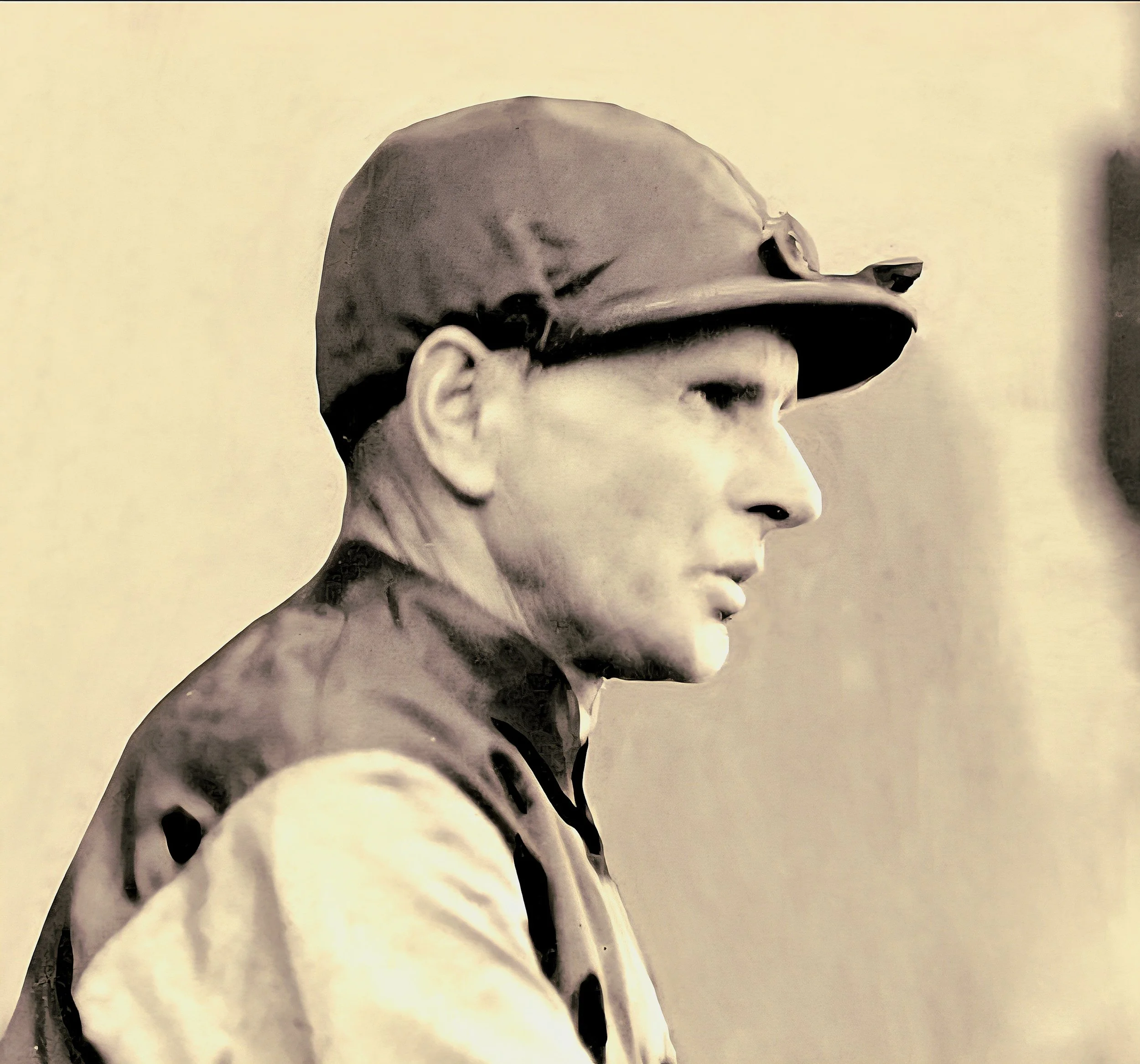
BOBBY LEWIS
A dominant figure in Australian racing for the first half of the twentieth century, Bob was almost sixty when he relinquished his licence in 1938, after a forty six year career.
ROBERT "Bobby/Bobbie" LEWIS was an Australian jockey of the late 19th century to the early 20th century. During his 46-year career span from 1892 to 1938 he won over 900 races. An absolute ironman of Australian racing, he rode a record-breaking 33 Melbourne Cup starts and secured four victories in the iconic race, 1902, 1915, 1919 and 1927. He also won eight Victoria Derbies, four Australian Derbies , seven Crown Oaks and eight AJC St. Legers.
Lewis was born in Clunes, Victoria, a small town north of Ballarat on 30 November 1878. Bob was one of nine children born to a Welsh miner Thomas Lewis, and his English born wife Martha Ann, who were both very proficient in the art of handling horses. Under the tutelage of his parents, and an elder brother who was a horse breaker, young Bob was quickly very much at home on horseback. His father prohibited him from using a saddle, until his balance was instinctive.
Lewis won his first race on the Clunes racing course in 1892 at age 14 in a pony event and his first metropolitan in Melbourne in 1895. In 1898 he went to England with his trainer J. E. Brewer but, homesick, quickly returned to resume a 40 year association with the master-trainer Jim Scobie. Bobby Lewis would find much success with Scobie's horses winning the 1927 Melbourne Cup on TRIVALVE and the Victoria Derby on MALSTER (1900), Hautvilliers (1901), SYLVANITE (1904), ALAWA (1908), WOLAWA (1912), and TRIVALVE (1927).
At 17 years old, Lewis would race in the 1895 Melbourne Cup on ONWARD, finishing among the tail enders in the thirty six horse field. He had unplaced finishes in the next four Melbourne Cups, before placing for the first time in the 1900 Melbourne Cup. Lewis would achieve his first Melbourne Cup on THE VICTORY in the 1902 Melbourne Cup, helped by the scratching of champion mare Wakeful. Lewis would have six more unplaced finishes in the Cup, before placing second in the 1909 Melbourne Cup on ALAWA, three lengths behind PRINCE FOOTE
In the 1915 Melbourne Cup Lewis replaced jockey William Smart on the three year old PATROBAS as the jockey couldn't make the Cup weight of 7st 6 lbs (47 kg). Lewis finished first earning him his second Melbourne Cup. The colt was brilliantly ridden, dodging a fall in the middle stages and then weaving a passage between horses to beat WESTCOURT. Bob shared in another piece of history, because the winner’s owner Mrs. E.A. Widdis became the first woman to own a Cup winner.
The accomplished horseman ran second on Shepherd King in 1916, before finishing out of a place the next two years. Lewis' third Melbourne Cup win was in the 1919 Melbourne Cup on the stallion ARTILLERYMAN. In winning the 1919 Melbourne Cup, lewis set a new race record time of 3 minutes 24.5 seconds. He secured victory by at least six lengths ahead of RICHMOND MAIN. Lewis in the following years would see a decreases in his racing wins but would maintain consistent placings through the 1920s and early 1930s. Lewis placed second in the 1924 Melbourne Cup on STAND BY. In 1926 lewis won the Caulfield Cup on MANFRED but did not race in the 1926 Melbourne Cup. In 1927 Lewis placed first in both the 1927 Victoria Derby and 1927 Melbourne Cup on TRIVALVE.
His four Melbourne Cup wins constitute a record that has only been equalled by Harry White, but never bettered. The champion jockey was down the course on EPILOGUE in 1928, and then came the Cup he wished had never happened. In the 1929 Melbourne Cup Lewis rode the favourite PHAR LAP after jockey Jim Pike was unable to get below the weight limit of 7st 6lbs (47 kg), where he was expected to achieve his fifth Cup.
PHAR LAP was the shortest priced Cup favourite ever, at the time, due to his recent back to back wins in the Australian Derby and Victoria Derby in record times. The three-year-old refused to settle under Bobby Lewis and only ran third behind fellow Night Raid-sired horse, NIGHTMARCH. Punters lost an estimated £1 million pounds as a result and it was suggested that Lewis conspired with his friend and punter Eric Connolly to lose on purpose. Connolly was known to be managing the Australian racing programme of Nightmarch for his NZ connections, which provided perfect fodder for the gossip and innuendo that followed.
Fifty year old Bobby Lewis, the pocket Herculean was the fall guy. To a significant degree, Phar Lap's own success contributed to his challenges. The limited field size led to a lack of pace, which was one of two crucial elements that resulted in his defeat. The other factor was the presence of Nightmarch.
Drawn on the rails, and with a smart beginning, Lewis was forced into leading the Cup field initially and was never worse than second in the running. But the pace was so slow for the first mile that Phar Lap wasted a lot of energy fighting for his head in those first six furlongs.
In the wake of his Cup defeat, most grandstand critics rounded on Lewis, while others muttered that perhaps Phar Lap might not be quite as good as believed and that Manfred was the better horse. Harry Telford partly blamed himself for the loss, as his instructions to Lewis had been to try and keep just behind the leader. “What if they walk?” asked Lewis. “You walk too!” was Telford’s response.
Lewis did not race in 1930 Melbourne Cup. Bob sat in the stand to watch Phar Lap destroy the opposition in the 1930 Melbourne Cup, but was there in 1931, for his last ride in the race that had been such an important part of his life. In the 1931 Melbourne Cup lewis rode 25/1 chance PRINCE DAYTON to sixth place. This was the last Cup Lewis would ride in and was not offered another Cup ride. Reports of the day highlight high regard for his own safety, and the safety of fellow riders.
He rode with a slightly longer stirrup leather than many of his contemporaries, which he believed gave him much better control in the event of a horse blundering or stumbling. He was careful not to restrict the racing room of rival riders, and always rode within the rules. It’s hard to believe he incurred only one suspension in a forty six year career, and that happened at Randwick in Sydney 1925. Even then, stewards were tentative in charging him, and with an ounce of luck he would have finished his long career with a pristine record.
Bob was a man of sober habits who enjoyed good health for his entire riding career. He enjoyed a Turkish Bath on race days, but never had to subject himself to excessive wasting and severe dieting. These are the reasons he was able to ride racehorses well into his fifties. Lewis continued to ride professionally for another seven years before retiring from horse racing in 1938. After retiring from horse racing in 1938 he become a grazier with properties in Glenroy and Ferntree Gully until his death on 31 March 1947. The VRC honours his contribution to racing with the running of the Gr 2 Bobby Lewis Quality at Flemington in September.
James Scobie simply said of Bob Lewis “He has been scrupulously attentive to duty, and always with clockwork regularity. He is right in every particular”.